Structure, Routine & Predictability: Why Dogs Thrive When They Know What Comes Next.
Nature-Inspired, Dog-Informed Training
Structure and routine for dogs can have a huge impact on confidence, behaviour and their ability to settle. Dogs don’t need every minute of their day scheduled. But they do benefit enormously from having a general idea of what comes next — and understanding what is expected of them when it does.
Structure, routine and predictability can help create a dog who feels more settled, confident and capable of switching off. When the patterns of everyday life make sense, your dog doesn’t have to constantly wonder:
Are we going somewhere? Is it time to eat? Are we playing? Should I follow you? Is something exciting about to happen?
Instead, they begin to understand the rhythm of their household.
And with understanding comes confidence.
Why Structure and Routine for Dogs Builds Confidence
Think about how much easier life feels when you know what to expect.
Dogs aren’t all that different.
When meals, walks, training, play and rest happen within a reasonably predictable routine, dogs begin recognizing the patterns surrounding those activities.
- Maybe breakfast comes after the morning walk.
- A walk could be followed by water and quiet decompression.
- Dinner might lead into a period of rest.
- As bedtime approaches, the household gradually becomes quieter before that final potty break.
Your dog isn’t simply learning what to do.
They’re learning how their day works.
That predictability can remove some of the uncertainty from their world and allow them to look to us for guidance rather than feeling like they need to manage everything themselves.
Routine Doesn’t Mean Living by the Clock
Structure doesn’t mean breakfast must happen at exactly 7:02 every morning.
Actually, I don’t necessarily want a dog who believes the clock determines when everything happens.
I want them to recognize a sequence and rhythm.
Potty → activity → decompression → food → rest.
Life changes.
Work schedules change. Weekends look different.
- Sometimes we sleep in.
- Dinner might be a little later than usual.
- The weather might change the walk we had planned.
A healthy routine should help your dog navigate those changes — not make them incapable of coping when something happens differently.
The individual activities can change while the underlying structure remains familiar.
Work – Rest – Play
One of the patterns I encourage families to think about is Work – Rest – Play.
We often put a huge amount of emphasis on physically exercising dogs.
Walk them longer.
Throw the ball again.
Run them.
Play more.
Wear them out.
But endlessly trying to exhaust a dog can sometimes create a dog who simply becomes better at being busy.
Physical exercise is important, but so are brain work, relationship building, decompression and sleep.
After activity, your dog doesn’t necessarily need another activity.
They may need to come back down.
After training, they don’t necessarily need more stimulation.
They may need an opportunity to process what they’ve learned and rest.
The ability to do nothing is a skill.
Some dogs naturally settle easily. Others need us to teach them that they don’t have to participate in every movement, sound or activity happening around them.
Mental Work Counts Too
Not every day has to include a long walk.
- Sometimes life happens.
- The weather doesn’t always cooperate.
- Your schedule may simply not allow it.
That doesn’t mean your dog’s needs have to be forgotten.
A focused 15–20 minute training session can be incredibly valuable. You can work on skills your dog already knows, introduce something new, play tug, practice impulse control or bring out some sniffing and scent games.
Mental stimulation asks your dog to think, problem-solve and engage with you.
The goal isn’t always to make your dog physically tired.
Sometimes the better questions are:
- Did we give them an appropriate outlet?
- Were they challenged mentally, not just physically?
- Did we spend some intentional time working together?
What This Looks Like in My Own Home
My own dogs, Leo and Diesel, have a fairly predictable weekday rhythm.
5:30 a.m. – Potty & Morning Activity
It isn’t something every dog owner needs to copy. It’s simply an example of how I’ve built structure into our household while still leaving room for real life.
We start our morning with an opportunity to potty and then usually head out for our walk.
But before we even get outside, there’s already a training opportunity.
Leo and Diesel wait at the door.
The door opening does not automatically mean go.
Whether we’re leaving for a walk, heading outside for a quick potty break or coming back into the house, the expectation remains consistent:
Pause at the doorway and wait for permission.
It’s a tiny part of our routine, but we’re practicing patience, impulse control, door manners and listening for direction every single time we enter or exit.
There’s a safety benefit too.
A dog who has practiced hundreds of times that an open door doesn’t automatically mean they can rush through it has a very valuable skill when it really matters.
If we aren’t walking that morning, I’ll substitute approximately 15–20 minutes of purposeful training or mental stimulation.
We might work individually on skills each dog needs, practice something we’ve already learned, play some tug or bring out sniffing and scent games.
The activity can change.
The structure remains familiar.
Around 6:15 a.m. – Decompression
When we get home, I shower and get ready for work while Leo and Diesel have time to come back down.
Sometimes that means simply settling. Other times they might have a safe bone or long-lasting chew while they decompress.
That transition is intentional.
We’ve gone from:
Activity → calm.
Not:
Activity → activity → activity.
It also gives their breathing and heart rates time to return to normal and allows their bodies to settle before breakfast.
Around 7:00 a.m. – Breakfast
The cats are fed first.
This isn’t because I’m establishing that the cats are somehow “higher ranking” than the dogs. It’s simply a routine I’ve intentionally created because it works well in our multi-pet household.
Leo and Diesel learn that another animal receiving a resource doesn’t mean they need to rush in or immediately receive something themselves.
- They learn to wait patiently.
- They can observe another animal receiving something without rushing in.
- They begin to understand that not every resource or activity belongs to them.
And we take that impulse control one step further.
While I’m preparing their meals, Leo and Diesel wait on the mat by the door.
They aren’t crowding me, circling their bowls or following me around the kitchen.
Their job is simply to wait.
Once their meals are ready, they remain on their mat until I release them with “get it.”
It’s a small routine, but think about everything we’re practicing:
Place. Patience. Impulse control. Spatial boundaries. Listening for a release. Manners around resources.
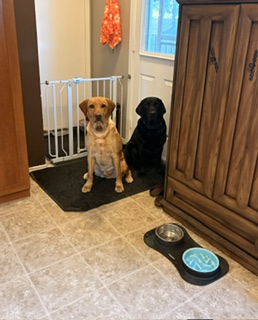
And we practice it twice every day without adding another formal training session to our schedule.
As I’ve talked about before, building a relationship with your dog happens through the everyday moments.
Breakfast → Potty → Rest
After breakfast, Leo and Diesel have another opportunity to go outside.
And there’s our doorway routine again.
Wait. Permission. Exit.
Then it’s time to settle.
They crate while I’m at work, giving them a predictable period for quiet rest and decompression instead of feeling like they need to patrol the house, watch windows or remain “on” all day.
If I’m working close enough to home, I’ll come back at lunch for a potty break.
If not, their next opportunity is as soon as I arrive home.
Coming Home Doesn’t Have to Be Chaos
When I get home, opening the crate door isn’t permission to explode through it.
I keep the release calm.
We maintain the crate manners we’ve already worked on before heading outside for a potty break — where we practice our doorway manners again.
This is an important part of structure that sometimes gets overlooked.
Predictability isn’t only about knowing what happens next. It’s also about knowing what’s expected of you when it happens.
Leo and Diesel know:
When food is being prepared, I wait on my mat.
An open door means I wait for permission.
The crate door opening doesn’t mean I need to rush out.
After activity, we come back down.
Those aren’t four separate obedience lessons.
They’re simply how we live together.
Dinner, Rest & Evening Activity
The same structure continues into the evening.
As I prepare dinner for the family and the dogs, Leo and Diesel return to their mat and wait.
Again, we’re practicing patience and impulse control rather than allowing hovering, demanding or escalating excitement around food.
Their meals are placed down, but they wait until they’re released with “get it.”
After dinner, we have another period of quiet rest.
Later, we generally head out for our evening walk.
Again, if the walk doesn’t happen, we can substitute purposeful training, tug or sniffing games.
Afterward, the house transitions into quieter evening time before the final potty break and bed.
Look at the Pattern
When you step back, our exact activities aren’t identical every day.
But the overall rhythm is fairly predictable.
Potty → Walk/Work → Decompress → Eat → Potty → Rest
Then later:
Potty → Engagement → Dinner → Rest → Walk/Brain Work → Decompress → Potty → Bed
Leo and Diesel aren’t watching the clock thinking:
“It’s 6:15. Decompression should begin now.”
They recognize the pattern.
That’s the important part.
Structure Can Reduce Constant Negotiation
Building consistency in everyday life is also one of the reasons I often recommend starting training in the home, where those daily patterns are actually happening.
Without clear patterns, some dogs begin creating their own.
- Following you from room to room.
- Staring at the food cupboard.
- Repeatedly bringing you toys.
- Pacing when you put your shoes on.
- Demanding attention.
- Becoming increasingly excited around certain times of day.
Sometimes we’ve unintentionally taught our dogs that they need to keep asking until something happens.
Structure can take some of that responsibility away.
- You manage resources.
- You manage movement.
- You manage space.
- You provide opportunities for activity.
- And you create opportunities for rest.
Your dog begins learning that their needs will be met without having to constantly demand or anticipate them.
Training Happens in the Everyday Moments
One of the phrases my mentor, Karen Laws, has instilled in me is:
“Training time is all the time.”
And it’s something I’ve come to appreciate more and more.
Training isn’t limited to a scheduled session with treats in your pocket. It’s happening throughout everyday life — often in moments we don’t even think of as “training.”
This is why I often say training is a lifestyle — it’s built into how we live with our dogs every day.
Think about how many repetitions Leo and Diesel get in an average day simply by living within our normal routine.
- Every doorway is an opportunity to practice impulse control.
- Every meal is an opportunity to practice patience and boundaries.
- Every crate release is an opportunity to practice calmness.
- Every walk is an opportunity to practice communication.
- Every transition from activity to rest is an opportunity to practice settling.
These little moments aren’t interruptions to our day.
They are the training.
You don’t necessarily need to find more time to train your dog.
Start using the time you’re already spending together with a little more intention.
Because the everyday moments add up.
And eventually, those little moments become habits — for both ends of the leash.
Predictability Doesn’t Mean Boring
Structure shouldn’t remove adventure from your dog’s life.
Explore a new trail.
Change your walking route.
Teach something new.
Let them sniff.
Play a different game.
Give them opportunities to problem-solve and experience the world.
Predictability provides the foundation from which we can enjoy those experiences.
A dog who understands how to engage, wait, settle, decompress and move through transitions has more skills available to them when life becomes exciting.
Start With the Small Things
You don’t need to completely reorganize your household tomorrow.
Start by looking at the patterns that already exist.
- What happens before your dog’s meals?
- What happens when you open the door?
- What happens after a walk?
Does excitement always lead to more excitement, or have you intentionally created opportunities to come back down?
Does your dog know when it’s time to engage with you — and when it’s time to simply exist nearby?
Are you providing both physical and mental outlets?
And perhaps most importantly:
Have you taught your dog how to rest?
Small routines become communication.
Consistent communication creates understanding.
And understanding helps build trust.
Structure creates clarity.
Routine creates understanding.
Predictability builds confidence.
Your dog doesn’t need you to schedule every minute of their life.
They need enough consistency to learn:
I understand how life works here.
I know what’s expected of me.
My needs will be met.
And I can settle because I don’t have to manage what happens next.
That’s bigger than obedience.
That’s relationship.
Nature Calls Dog Training
Nature-Inspired, Dog-Informed Training
Connection beyond commands.

Be the first to comment